
Curved forms are becoming a defining feature in contemporary interiors. From flowing wall panelling to intricate details, designers are increasingly looking to move beyond straight lines. The challenge, however, is delivering these ideas in a way that remains practical, cost-effective, and practical.
This is where curved laminations add real value, bridging the gap between design intent and manufacturing reality within bespoke joinery projects.
Example: Curved Wall Panelling
Seamless finishes for complex architectural spaces
Curved wall panelling allows veneered surfaces to flow continuously around a space, rather than stopping at sharp transitions. This is particularly effective in areas such as stairwells, atriums, or feature walls where the architecture naturally introduces curvature.
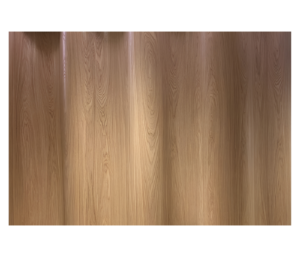
Instead of breaking the design into flat sections, curved laminations enable a consistent finish across both straight and curved elements. Veneer matching remains uninterrupted, resulting in a more cohesive and refined interior.
What this enables:
- Freedom to design around curves rather than simplifying layouts
- Seamless integration of curved corner panelling
- Cost-effective delivery of flowing or wave-form feature walls
For contractors, this also removes uncertainty around how these details will be manufactured, making it easier to price and deliver complex design intent.
Example: Bespoke Column Casings
Design-led alternatives to standard encasements
Columns are often necessary, but they should be made a feature. Standard encasement systems can limit design flexibility, resulting in elements that feel disconnected from the wider interior.
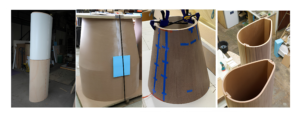
Curved laminations allow for fully bespoke column casings, shaped precisely to suit the architectural intent. Profiles can be elliptical, tapered, or even change along their height, turning structural elements into design features.
What this enables:
- Bespoke profiles beyond standard catalogues
- Column casings that reduce, flare, or shift in section
- Alignment with the overall interior design language
This flexibility gives designers more control while maintaining confidence that the solution remains manufacturable.
Example: Curved Acoustic Panels
Performance-led acoustics without visual compromise
In sectors such as education, offices, and hospitality, acoustic performance is essential. However, traditional acoustic treatments can limit design possibilities or visually dominate when you do not want them to.
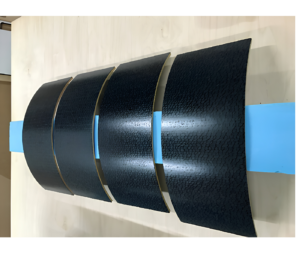
Curved laminated panels allow acoustic requirements to be addressed without compromising aesthetics. Panels can be designed to absorb, diffuse, or direct sound while maintaining a high-quality veneered or painted finish.
What this enables:
- Panels shaped around acoustic performance needs
- Single and multi-curve wall or ceiling applications
- Finishes that integrate seamlessly with the interior scheme
This creates spaces that both look right and perform effectively, without trade-offs between design and function.
Example: Furniture Prototyping & Development
Fast exploration of form before committing to tooling
Curved laminations are not limited to architectural applications. They also support early-stage product development, particularly for furniture designers exploring complex forms.
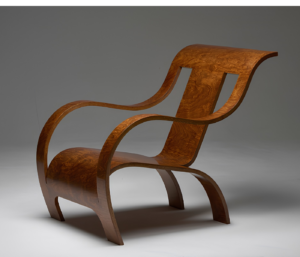
By enabling rapid prototyping of curved components, designers can test multiple variations before committing to production tooling. This reduces both time and cost risk during development.
What this enables:
- Faster iteration of curved seat and back profiles
- Greater confidence in ergonomics and visual balance
- Reduced investment risk before full production
It’s an approach that supports innovation, allowing ideas to be explored and refined earlier in the process.
Delivering Curved Joinery with Confidence
Despite growing demand, curved elements are still sometimes avoided at the tender stage due to uncertainty around cost and delivery. Many contractors are unsure who can reliably produce these features to the required standard.
Combining CAD design, material expertise, and CNC manufacturing helps remove that risk. When curved elements are planned early and supported by accurate drawings and pre-production samples, they become a controlled part of the joinery package rather than a complication.
This aligns with the need for clarity, precision, and reliability across modern fit-out projects, where reducing rework and maintaining programme certainty is critical.
A More Flexible Approach to Joinery
Curved laminations are not just a specialist capability; they are becoming a practical tool for delivering more refined, design-led interiors.
For designers, they unlock greater creative freedom.
For contractors, they provide confidence in delivering complex details.
For clients, they result in spaces that feel intentional, cohesive, and well resolved.
If you’re exploring curved elements in an upcoming project, our team can help you assess feasibility early, ensuring design intent is maintained without introducing risk to programme or cost.
